
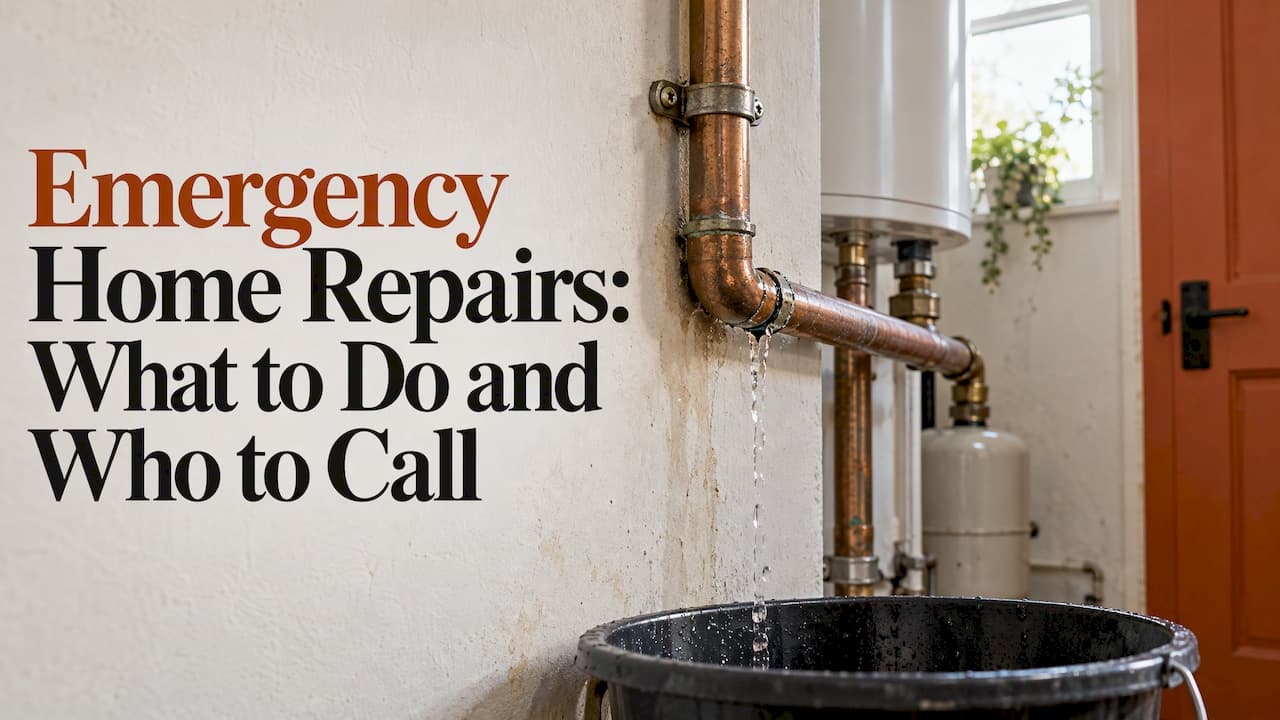
An emergency home repair is any fault that is causing, or could cause, serious harm to your health, your safety or your property right now: a gas smell, a burst pipe, exposed live wiring, a home you cannot secure. Do three things in order. Make yourself safe, stop the damage if you can do so safely, then call the right professional for the fault. This guide shows you how, and how to check the person you hire when you are under pressure.
TL;DR
-
Gas smell or suspected carbon monoxide: leave the building and call the National Gas Emergency Service on 0800 111 999. Do not ring a plumber first.
-
Water escaping: turn off the main stop tap, switch off the central heating, and switch off the electrics at the mains if water has reached them.
-
Before you let anyone in, check the register: Gas Safe for gas work, WaterSafe for plumbing, and ask to see ID.
-
Agree the attendance fee, the hourly rate, the billing unit and whether VAT is included before anyone travels.
-
Tenants: report emergencies to your landlord in writing straight away. For many repairs, the landlord is the one who must arrange and pay.
Table of Contents
What counts as an emergency home repair
The clearest official definition comes from GOV.UK’s guidance on Awaab’s Law, written for social housing tenants in England. It describes an emergency hazard as something that needs fixing right away because it is causing or could cause serious harm to health or safety. Its examples are a good checklist for any home, rented or owned:
-
gas or carbon monoxide leaks
-
a broken boiler
-
no water supply at all
-
dangerous electrical problems such as exposed wires
-
major leaks
-
broken external doors or windows that leave the home unsafe
-
very serious damp or mould
-
major structural problems
Housing providers draw the line in similar places. One housing association, Twenty11, treats total loss of electrics, sparking power, loss of mains water, an uncontainable leak, fire, flood, severe roof damage or an unsecured home as same-day emergencies. Its 24-hour category covers a blocked or overflowing sewage drain, a partial power loss, partial loss of water and, between 31 October and 31 March, no heating.
That second tier matters. Plenty of problems feel like emergencies but can safely wait for the next sensible appointment: a dripping tap, a slow drain, a single dead socket on an otherwise working circuit. The test is whether anyone is at risk or whether damage is spreading while you wait.
The first ten minutes: make the home safe
What you do before the trade arrives often decides how bad the damage gets. Know where your stop tap and your electrical consumer unit are before you need them. The Association of Plumbing & Heating Contractors stresses that knowing what to do and acting quickly can reduce serious damage, and in some cases even save a life.
If water is escaping
-
Turn off the water. The same APHC guide says every UK property has two stop taps: the main internal one, usually in the kitchen or on the ground floor, and the water company’s boundary stop tap. Start with the internal one. It is often under the kitchen sink.
-
Switch off the boiler and central heating. WaterSafe advises turning off the boiler as part of the first response to a burst pipe.
-
Drain the system. If the water cannot be controlled at once, CIPHE says to open all cold taps and flush the toilet so the pipework and storage drain quickly. It is explicit about one thing: do not turn on hot taps.
-
Mop up and protect. Soak up escaping water with towels and move belongings out of the way.
-
Check the electrics. WaterSafe’s guidance is to switch off the electrics at the mains if water has leaked near them. Do not touch switches or sockets standing in water.
-
Photograph the damage before you clear up, and keep every invoice and report. If you are insured, your insurer will ask for them.
If you smell gas or suspect carbon monoxide
Gas is the exception to “call a plumber”. Open doors and windows, do not operate switches or light flames, leave the building, and call the free 24-hour National Gas Emergency Service. CIPHE gives the number as 0800 111 999. Once the supply is made safe, only a Gas Safe registered engineer should work on the appliance or pipework.

If the electrics are dangerous
Sparks, a burning smell from a socket, exposed wires or a total loss of power across the home all call for an electrician, not a DIY fix. Switch off at the consumer unit if you can reach it safely and dry-handed, keep everyone away from the fault, and call an electrician. If there is fire, call 999.
If the home is not secure
A smashed window or a door that will not lock is an emergency because of the risk to you and your belongings. Board up or cover the opening temporarily, take photographs, and call a glazier or carpenter, plus the police if there has been a break-in.

Urgent plumbing problems that need a plumber now
Most searches in this area are about plumbing, because water causes damage fastest. Ring a plumber straight away when:
-
water is flooding a room or coming through a ceiling
-
a pipe has visibly burst or cracked
-
there is no water at all across the property
-
sewage is backing up into sinks, toilets or baths
A blocked toilet is a same-day issue when it is the only one in the home and the cause is the external drain. A boiler failure in winter can become urgent quickly, especially for older or vulnerable people or households with young children.
Some faults are urgent but not emergencies: a leaking radiator valve you can catch in a bowl, or a tap that will not stop dripping. Isolate it, contain it, and book a normal appointment. You will usually pay less than for an out-of-hours call-out, and you can compare quotes properly.
How to find and check an emergency plumber
Stress is exactly when people hire the first number they find. That is also when rogue traders do well. A two-minute check is worth it.
For plumbing: the WaterSafe Register is the UK’s directory of approved plumbers. According to WaterSafe, each approved business must carry £2 million of public liability insurance and, where appropriate, £5 million of employers’ liability cover. Plumbers employed by an approved business need at least an NVQ level 2 in a plumbing-related discipline and a Water Fittings Regulations qualification. The register covers England, Wales, Scotland and Northern Ireland, and you can search it by postcode.
For gas work: the engineer must be on the Gas Safe Register. Check the register online and ask to see their ID card when they arrive. If they cannot show it, do not let them touch the appliance.
For electrical work: ask which scheme they are registered with, and ask for the certificate for any notifiable work once the job is finished.
Questions to ask on the phone:
-
Are you registered, and what is your registration number?
-
Who is attending, and can I see ID when they arrive?
-
What is your attendance fee, if any?
-
What is your hourly rate, and how do you bill after the first hour?
-
Do those prices include VAT?
-
Do you carry insurance for this work?
Write the answers down or ask for them by text. A trade who is happy to confirm in writing is easier to hold to the price afterwards.
What emergency call-outs cost, and how to avoid a nasty surprise
Emergency prices vary widely by region, time of day and the nature of the fault, and many firms do not publish rates at all. Out-of-hours, overnight and bank holiday work usually costs more than a weekday daytime visit. Rather than quote a headline figure that may not match your area, protect yourself with the four things to pin down before anyone travels:
-
The attendance fee, if there is one, and whether it is deducted from the repair cost.
-
The rate, and exactly what it covers (labour only, or labour plus standard parts).
-
The billing unit after the first hour: per hour, per half hour or per quarter hour.
-
VAT: whether every figure includes it.
Ask for a firm price for the make-safe visit, and ask the trade to stop and tell you before the cost goes beyond it. If the job turns out to be bigger than a make-safe, you have the right to pause and get other quotes for the permanent repair.
What to expect when the trade arrives
The first visit is usually about making things safe, not finishing the job. Expect the trade to isolate the supply, apply a temporary fix if one is possible and tell you what a permanent repair involves. A burst pipe may be capped off today with the replacement section arranged for a later visit. A part for an older boiler may need ordering.
That is normal. Ask for the findings and the proposed permanent repair in writing, with an itemised price, so you can compare it against other quotes. Keep the invoice and any report, and photograph the finished work.
If the work seems unsafe, incomplete or not what you agreed, stop payment of any remaining balance until it is sorted, put your complaint in writing and keep your photographs. For gas or electrical work, you can report an unregistered or unsafe installer to the relevant scheme.
Renting? Who has to arrange and pay
If you rent, the first call is to your landlord or managing agent, in writing as well as by phone. Shelter England says private landlords, housing associations and councils must sort out repairs to wiring, gas pipes and boilers, heating and hot water, plumbing and drains, and that the landlord is always responsible for these even if the tenancy agreement says nothing. Council and housing association tenants have a 24-hour emergency repair obligation.
For social housing in England, Awaab’s Law guidance states that emergency hazards such as gas leaks, broken boilers, no water and dangerous electrics must be investigated and made safe within 24 hours. Rules differ across the UK nations, so check the position for where you live.
If you cannot reach your landlord and the situation is dangerous, make it safe first (turn off water, gas or electricity as above), and then record every attempt to contact them. Do not commission large repairs yourself without agreement, or you may struggle to recover the cost.
Landlords and property managers are better placed when they already hold the details of vetted trades for each service type before something fails at 2 am. A shortlist of checked plumbers, gas engineers and electricians for each property area saves time when it matters.
Perspective
Most people meet a trade for the first time in the worst possible moment: water through the ceiling, no heating, a stranger on the doorstep and a price they cannot judge. That is when trust is thinnest and mistakes are most expensive.
We built Fettld around that problem. Every trade quoting on our platform goes through identity, business, insurance and registration checks first. When you hire through us, your money is held as a deposit by Fettld until you approve the work, not paid straight to the trade. If something isn't right, you can raise a problem before it is released, and nobody has to chase you for money you have already put aside.
Our approach to emergencies is simple. Make the home safe first. Then use the calm that follows to get the permanent repair done properly: post the job, compare fixed, itemised quotes from up to five trades, and pick the one you trust. Trades do not pay us for leads, subscriptions or commission, so they are not pushed to inflate quotes to cover the cost of finding work.
Better decisions come from clear information. That is what we aim to give both sides.
Raivis
Get the permanent repair done properly
Once the immediate danger has passed, the permanent repair is where most of the money is spent, and where a clear, itemised quote helps most. Fettld lets you post a job for free and compare quotes from verified, ID-checked and insured local trades, with no obligation to accept. Our fees for leads, quotes and shortlists are £0, and there is no subscription or joining fee for trades and no commission on jobs, as set out on our pricing page. Your money is held as a deposit by Fettld until you approve the work.

Browse by trade if you know what you need: plumbers, gas engineers, electricians or heating engineers. You can also see where we cover, including plumbers in Manchester and gas engineers in Leeds.
Be ready before something goes wrong
A little preparation turns a crisis into an inconvenience.
-
Find your stop taps now. Label the internal stop tap and check it turns. Stiff taps are common if they have not moved in years.
-
Know your consumer unit. Make sure everyone in the household knows where it is and how to switch off.
-
Keep key numbers together. Your landlord or agent, your insurer’s claims line, the gas emergency number and a vetted plumber and electrician.
-
Service your boiler. A yearly service by a Gas Safe registered engineer is the simplest way to cut down on winter breakdowns.
-
Check the cold-weather risks. Lagging exposed pipes and knowing how to drain down the system helps before a freeze.
-
Keep a basic kit. A torch, towels, a bucket and a phone charger are all you need for most first responses.
FAQ
What counts as an emergency home repair?
Anything causing or likely to cause serious harm to health, safety or the building right now. That includes gas or carbon monoxide leaks, burst pipes and major leaks, no water, dangerous electrics, a broken external door or window that leaves the home unsafe, and serious structural damage. Problems that can safely wait for a normal appointment are urgent, not emergencies.
What should I do first if a pipe bursts?
Turn off the main stop tap, switch off the boiler and central heating, and open the cold taps to drain the system. Do not run hot taps. If water has reached electrics, switch off at the mains and keep clear. Then call a registered plumber.
How do I find an emergency plumber I can trust?
Search the WaterSafe Register by postcode, and for anything involving gas, check the engineer on the Gas Safe Register and ask to see their ID card. Confirm the attendance fee, hourly rate, billing unit and VAT on the phone before they travel. Keep the confirmation in writing.
Who pays for emergency repairs in a rented home?
Usually the landlord. Shelter England says landlords must deal with repairs to wiring, gas, boilers, heating, hot water, plumbing and drains, whether or not the tenancy agreement mentions them. Report the problem in writing straight away, and make the home safe while you wait.
Can I use Fettld for an emergency?
Fettld is built for comparing free, itemised quotes from verified local trades, so it suits the permanent repair that follows an emergency, or an urgent job you can brief a few hours ahead. For gas leaks or danger to life, call the emergency services or the gas emergency number first.